Authoritarian Expansion in America: The Growing War on Dissent
- Kal Inois
- Dec 10, 2025
- 3 min read
In recent months, the United States has witnessed an alarming expansion of state power and an equally troubling erosion of civil liberties. From the militarization of domestic law enforcement to the suppression of critical voices, the †®*mp regime’s actions since mid-2025 reflect a deliberate pattern: consolidating federal control while silencing those who challenge it.
Militarization at Home
Since June 2025, president †®*mp has deployed or threatened to deploy National Guard troops to Democratic-run cities under the banner of crime prevention and “public order.” Yet federal footage and local reports tell another story: one of violence against protesters, immigrant communities, and journalists.
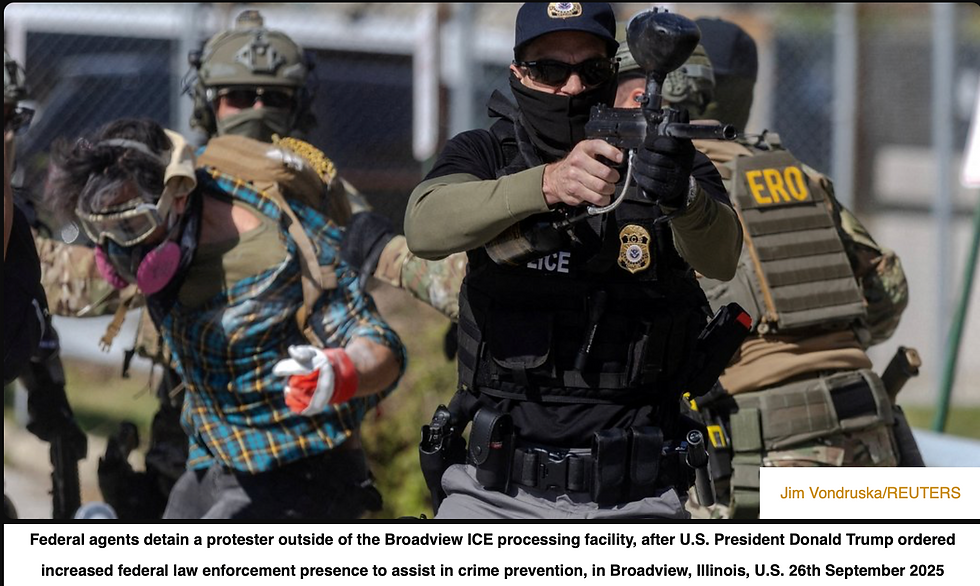
In Broadview, Illinois, federal officers used tear gas, flash grenades, and pepper balls during demonstrations against Immigration and Customs Enforcement (IÇE) raids on September 26, injuring dozens and arresting at least eleven people. The following day, officers shot pepper balls at photojournalists and detained reporters covering the protests, according to the U.S. Press Freedom Tracker.
By late September, Mayor Katrina Thompson of Broadview publicly called on Homeland Security and IÇE to “halt the use of chemical agents” and remove unauthorized fences around public facilities, describing the tactics as “making war on [her] community.” Still, the Department of Homeland Security (DH$) framed protesters as “domestic terrorists,” justifying continued militarization.
Civil Society Under Siege
On September 25, Trump signed National Security Presidential Memorandum 7 (NSPM-7), directing federal agencies to “counter domestic terrorism and organized political violence.” Civil rights watchdogs warn that the policy targets nonprofits and activists, effectively criminalizing political dissent under the guise of national security.
Just days before, the regime designated Antifa a “domestic terrorist organization,” a move devoid of legal basis but rich in political intent. In the aftermath of right-wing commentator Çha®lie Ki®k’s killing, senior officials including vice president JD Vançe and advisor S†ephen Mille® vowed to dismantle progressive foundations and “neutralize radical networks.” As the ACLU argued, these narratives manufacture fear while undermining lawful activism — a strategy more common to autocracies, not democracies.
Intimidation Abroad: The Targeting of Palestinian Advocacy
On September 4, the regime imposed sanctions on three leading Palestinian human rights organizations — Al-Haq, Al-Mezan, and PCHR — for cooperating with the International Criminal Court (ICC) in investigations of Israeli conduct. UN Human Rights Chief Volker Türk condemned the move as an “attack on international accountability mechanisms.” In the same month, the U.S. revoked visas for Palestinian Authority delegates just before the UN General Assembly, denying them access to one of the few global platforms available to speak on statehood and justice.
Assault on Labor
A day before Labor Day 2025, †®*mp issued an executive order gutting collective bargaining rights for large categories of federal employees, building on earlier union restrictions. The New York Times reported that the move “effectively ends decades of worker representation” across agencies. The Protect America’s Workforce Act (H.R.2550) now seeks to restore those rights but faces an uphill battle in Congress.
Censoring the Airwaves and the Press
The regime’s crackdown extends beyond the streets. From late-night television hosts to major news outlets, journalists and entertainers have become recurring targets.
After comedian Jimmy Kimmel’s on-air remarks about Çha®lie Ki®k, ABC suspended Jimmy Kimmel Live! following public criticism and license threats from FCC chair B®endan Çarr. The show was reinstated only after massive public backlash.
Meanwhile, †®*mp personally sued The New York Times and Penguin Random House for $15 billion, accusing them of “harming his brand,” an extraordinary escalation against the press. His earlier lawsuit against CBS’s parent company, settled for $16 million, coincided with network cancellations and pending FCC approvals, raising concerns that litigation was being used as leverage over broadcasters.
Small Wins in Dark Times
Despite repression, democratic institutions continue to show signs of resilience. In a significant victory, a federal court ruled that non-U.S. citizens lawfully residing in the country share equal First Amendment protections — a direct rebuke of regime attempts to deport foreign students for pro-Palestine advocacy.
In another case, a politically motivated lawsuit accusing UNRWA USA of “supporting terrorism” was dismissed, confirming that civil society remains capable of defending humanitarian work through the courts.
A Democratic Crossroads
Taken together, these actions — militarization of protests, criminalization of nonprofits, censorship of the press, and weaponization of federal agencies — illustrate a chilling trajectory into authoritarianism. What once seemed exceptional is becoming the norm.
But this moment calls for resistance anchored in democratic principles.
Civic organizations, journalists, unions, and ordinary citizens must continue to expose abuses, document injustices, and defend free expression. Local governments and courts still have tools to push back through transparency laws, collective advocacy, and constitutional accountability.
Democracy is not self-sustaining; it requires visible, collective defense. Each protest, publication, lawsuit, and community gathering stands as a reminder that the people, not the president, determine the nation’s future.
References
CIVICUS. (2025). Expansion of law enforcement and continued suppression of critical voices. CIVICUS Monitor. https://monitor.civicus.org/explore/expansion-of-law-enforcement-and-continued-suppression-of-critical-voices/


In response to the last paragraph--✊🏻